Why Going Ductless Is the Smart Choice for Non Ducted Connecticut Houses
Why Going Ductless Is the Smart Choice for Non Ducted Connecticut Houses
Many homes across Durham, Middletown, Middlefield, Killingworth, and the broader Middlesex County area were built without ductwork. That makes summer cooling a challenge and winter comfort a balancing act. Window ACs are loud, drafty, and hard on energy bills. Space heaters do not belong in bedrooms or apartments with strict insurance rules. This is where a purpose-built single-zone or multi-zone ductless heat pump solves the problem with clean installation and precise comfort control.
For homeowners who want Ductless Mini-split Installation Durham CT, the logic is simple. A ductless heat pump places a compact outdoor unit outside and a quiet indoor unit in the room that needs heating and cooling. The system uses an inverter-driven compressor, which means it varies output to match the load instead of toggling on and off. The result is steady temperature, low sound, and strong efficiency in both humid summers and cold winters. In a region with a long heating season and sticky July air, that matters every day.
Direct Home Services installs and services ductless systems across central Connecticut, from the Durham Fair Grounds area and Route 17 corridor to the 06457 Middletown market near Wesleyan University and the Route 9 interchange. The team understands older oil-heated homes, finished attics with no returns, tight lake cottages around Lake Beseck in Middlefield, and post-and-beam renovations in Haddam and Madison where duct runs are not desirable. Ductless is often the cleanest fix and the fastest path to real comfort.
Why ductless solves non-ducted homes in Middlesex County
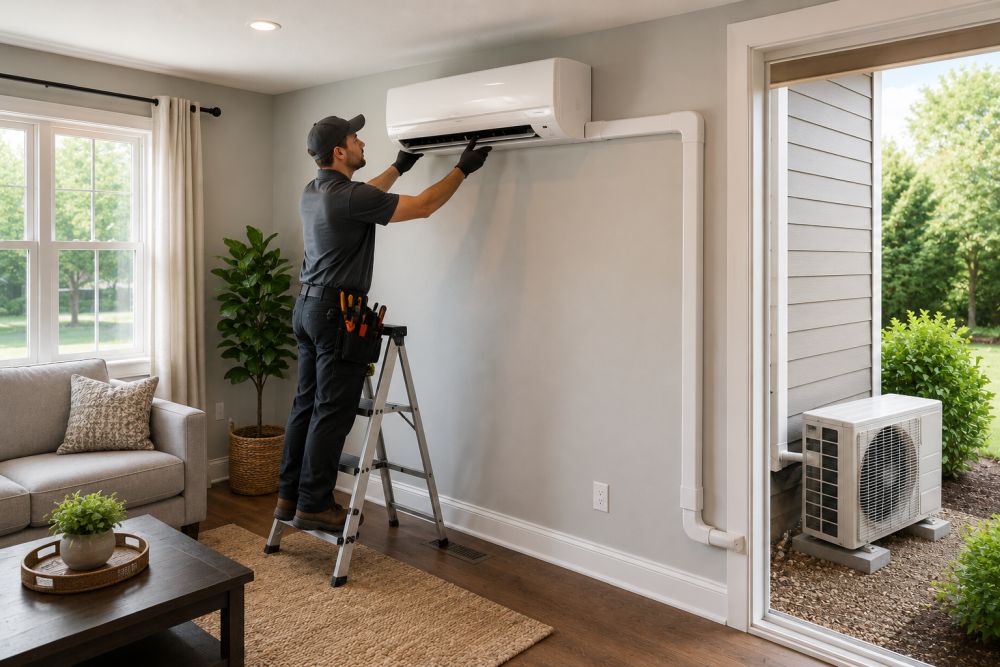
Older housing stock in Durham 06422 and neighboring towns often lacks the space for full supply and return trunks, or the home’s finish work cannot be disturbed. A ductless mini-split avoids large-scale carpentry. A small three-inch opening through an exterior wall routes the lineset, which is the insulated tubing that carries refrigerant, along with the condensate drain and control wire. The installer mounts a wall, floor, or ceiling cassette inside and sets a modest outdoor unit outside. The crew tests the refrigerant charge, which is the exact amount of refrigerant in the system, and commissions the equipment. The home keeps its original character and gains zoned comfort.
Central Connecticut sits in climate zone 5A. The winter design temperature falls near 0 degrees. Modern cold-climate ductless heat pumps maintain a large share of their heating capacity at that condition. That fact surprises people who remember early heat pump models that struggled in New England winters. Today’s variable-speed equipment delivers heat even when the Connecticut River valley wakes to single digits. One indoor unit heats a finished attic or an addition. Multiple indoor units can serve the main level and upstairs if the home needs full-house coverage without ducts.
Because the indoor unit and outdoor unit connect directly, the system avoids the energy loss common in long leaky duct runs. That is a major reason ductless systems earn high SEER2 (seasonal cooling efficiency) and HSPF2 (seasonal heating efficiency) ratings. The inverter compressor ramps down when the load falls, which saves energy in shoulder seasons and late nights. In Durham and Wallingford, that smoother operation removes humidity better in July than the short, loud cycles homeowners expect from window ACs.
Where single-zone ductless shines in local homes and small businesses
Single-zone ductless mini-splits target one space. They are ideal for a bonus room over a garage on Route 79, a finished basement office in Cromwell 06416, or a sunroom in Madison 06443 with big glass exposures. In Middletown 06457, landlords often choose single-zone ductless for third-floor walk-ups near downtown where adding ducts is not practical. In Killingworth 06419, single-zone ductless works well for ranch expansions and backyard studios. The installer sizes the BTU capacity to the space, routes the lineset along a path that hides well against the siding, and selects the right indoor head for the room layout.
Noise is a constant complaint with window ACs. A wall-mounted ductless head runs quietly. Outdoor units sit on pads or brackets and stay calm, even on spring nights when neighbors’ windows are open. Rooms cool faster because the supply air comes from the right place. Rooms heat faster because the unit engages heat pump mode immediately. The thermostat sensor sits in the indoor unit, which reads the room temperature instead of a hallway. That solves the common problem of a room falling out of sync with a central stat located far away.
What Middlesex County homeowners should expect from a well-engineered ductless installation
Proper design starts with a load calculation. A Manual J calculation estimates the heating and cooling load based on insulation, window area, orientation, and infiltration. This is not guesswork by square footage alone. In Durham Center or near the Coginchaug River corridor, two similar capes can require different sizes due to solar gain and air leakage. The installer selects capacity using Manual S, which is the equipment selection method that matches real output to the calculated load. Oversizing a ductless head leads to short cycles and poor humidity control. Undersizing leads to a system that never catches up in a heat wave.
Placement matters. A wall-mounted indoor unit should not blow straight into a door or be tucked behind a beam. Floor-mounted units help in knee-wall spaces and historic rooms on Main Street where a high wall head would look out of place. Ceiling cassettes fit well in kitchens and open-plan areas, but the ceiling framing and joist spacing must cooperate. A site visit determines which head style fits the space and the homeowner’s finish preferences.
The lineset route is more than a drill point. It affects performance and service access. A professional keeps lineset length within the manufacturer’s guidelines, supports it on the exterior, protects it with covers, and prevents kinks that would hurt refrigerant flow. The installer pulls a deep vacuum on the lines to remove moisture and non-condensables before releasing the factory charge, then verifies the refrigerant charge by measuring subcooling and superheat, which are temperature differences that confirm the system has the correct amount of refrigerant. Electrical work includes a dedicated circuit, proper outdoor disconnect, and code-compliant wire sizing. Condensate management must send water to grade or a drain line with the correct slope. When the head sits below grade, a condensate pump may be needed. Each detail keeps the system safe and reliable during a July storm or a February freeze.
How ductless handles real Connecticut weather and older home quirks
Humidity is a defining feature of summers along Route 9 and the I-91 corridor. Ductless systems excel at indoor moisture control because the inverter compressor can hold lower fan speeds and longer cycles. Lower airflow over a cold evaporator coil improves latent removal, which means more water pulled from indoor air. Homeowners notice that a 74-degree setpoint feels comfortable because humidity drops.
In winter, a cold-climate heat pump uses a reversing valve to switch the refrigerant flow and pull heat from outside air. That sounds counterintuitive on a 10-degree morning in Middlefield 06455, but physics allows the refrigerant to absorb heat at low temperature and move it indoors. The coefficient of performance, or COP, is the ratio of heat delivered to energy used. Even at low outdoor temperatures, a modern cold-climate heat pump can deliver more heat energy than the electrical energy it consumes. That is why many homeowners in Haddam 06438 and Rockfall 06481 now supplement or replace oil with ductless heat pumps, especially when paired with Energize CT and Eversource rebates and the federal credit referenced later in this article.
Rooms in older capes and colonials often have odd duct paths or no returns. Ductless bypasses that. The indoor unit measures and conditions the air in the room where people live. Doors can stay open for air movement through the home, but comfort no longer depends on swinging air from a single central supply. Overheated upstairs bedrooms in Wallingford 06492 and Meriden 06450 become even, calm spaces in July. Winter hot spots and cold spots shrink when each zone gets the output it needs.
Equipment and refrigerant considerations that matter in 2026
Two efficiency ratings help homeowners compare options. SEER2 describes average seasonal cooling efficiency. HSPF2 describes seasonal heating efficiency. Higher ratings usually mean lower energy use, but only when the system is sized and installed correctly. A system with a high nameplate rating can waste energy if it is oversized or the lineset was not evacuated correctly. Performance is earned in the field during installation and commissioning.
Ductless systems have used R-410A refrigerant for many years. Many manufacturers are now shifting to lower global warming potential refrigerants such as R-32 or R-454B. Homeowners who want Ductless Mini-split Installation Durham CT should ask about refrigerant type, serviceability, and future supply. Direct Home Services services and installs ductless systems from major brands, features Bryant as the company’s authorized-dealer brand, and also works on Carrier, Trane, Lennox, American Standard, Mitsubishi Electric, Daikin, Bosch, Rheem, and Goodman equipment. The team explains differences in refrigerant, available parts, and installer training across brands so the homeowner can make a clean decision for their home.
The indoor unit style should match the room. A wall-mounted indoor unit works in most cases and keeps costs down. A floor-mounted unit makes sense in rooms with low knee walls or sloped ceilings, which are common in second-story conversions on the Durham and Middlefield line. A ceiling cassette solves open areas where a wall location would throw air at seating or into cabinets. The final choice balances airflow pattern, appearance, and where the lineset can travel outdoors without clashing with a historic façade along Main Street.
Use cases that often move homeowners away from window ACs
Window ACs create noise, block views, and leak air. They also invite mold risk if condensate management fails. In Durham and nearby towns, many homeowners replace them as soon as one room gets a ductless head. The difference is immediate. The system is quiet, doors close without the window sash in the way, and the room is comfortable in April, July, and November. The investment serves all seasons, not just a short summer window.
- Finished attic or bonus room where duct runs are not possible
- Sunroom, porch conversion, or garage studio that suffers in July humidity
- Historic living room where trim and plaster should remain intact
- Basement office or in-law suite that needs heat and cooling with its own control
- Small business suite near Route 68 or Route 17 that needs a quiet zone
Each of these spaces benefits from a single-zone ductless unit. The installer sizes the BTU output to the room, locates the indoor unit to prevent drafts on seating or beds, and routes the lineset to a spot that protects the siding’s look. In many cases, this can be done in a day without disrupting the rest of the house. The crew protects floors, confirms electrical capacity, and cleans up outside. The result is a neat exterior with matching line-hide covers and a tidy outdoor pad or wall bracket that sheds snow in winter.
What homeowners mean by “cold-climate” and why it is not marketing fluff
A cold-climate heat pump, often abbreviated as ccASHP, is built to heat well at low outdoor temperatures common to climate zone 5A. The key is the inverter-driven compressor and the outdoor coil design. Capacity at 5 to 10 degrees stays useful instead of dropping off a cliff. The defrost cycle logic is smarter than past generations, which protects both comfort and energy use. In towns along the Connecticut River and up Route 17, many families now use ductless for primary heating with supplemental heat only on the rare arctic snaps. Others run ductless heads as the main heat in finished spaces and leave older boilers or furnaces as a backup for the coldest nights. Either way, the run time on oil or propane drops.
The difference shows up in energy bills and daily comfort. An inverter maintains supply air that feels warm to the skin and stable to the thermostat. That is different from the blast-then-coast cycle of equipment that cannot modulate. Humidity control improves, drafts fade, and doors do not have to stay open to chase a cold hallway thermostat. Homeowners often comment that the space feels cleaner because the indoor unit has washable filters that catch dust near the source. For homes with indoor air quality concerns, a whole-home media filter or UV-C purifier can be paired with other systems to improve air across the rest of the home as well.
General-market cost ranges and how rebates change the math
Every home is different, so a site visit sets the real number. As a general market reference, homeowners often see a wide range. A single-zone ductless mini-split installed by a licensed contractor can land in a general range that starts in the mid thousands and runs upward depending on capacity, lineset distance, electrical, and head style. Multi-zone systems that serve several rooms naturally cost more due to multiple heads, longer lines, branch boxes on some models, and more labor. Exact pricing requires an in-home assessment and a written quote. For Ductless Mini-split Installation Durham CT, that assessment reviews room loads, electrical panel capacity, lineset routes, and outdoor unit placement given snow and landscaping.
Rebates and tax credits can offset part of the project. Direct Home Services supports Energize CT and Eversource rebate coordination and federal IRA tax credit assistance for heat pump technology. The site frames available incentives as up to $6,000 in rebates in some cases and an up-to-$2,000 federal heat pump credit, subject to program terms. Incentives change and depend on equipment, efficiency ratings such as SEER2 and HSPF2, and household eligibility. The company explains what applies to a specific address in Durham 06422, Middletown 06457, or Wallingford 06492 and helps with paperwork so homeowners do not leave value on the table.
Engineering details that separate a durable system from a problem child
Mini-split systems are unforgiving to poor practices. Flaring, which is the process of shaping copper tube ends to connect fittings, must be clean and sized right or it will leak. A torque wrench on flare nuts prevents over-tightening. A micron gauge verifies a deep vacuum during evacuation. A nitrogen purge while brazing prevents oxides inside the lines. The installer adds line insulation of the correct thickness to control condensation and wraps fittings that sit outdoors. The final startup checks include verifying fan speeds, measuring supply and return temperatures, confirming defrost logic, and calibrating the indoor unit’s sensor location in relation to the room layout.
Electrical details matter too. A ductless system needs a dedicated circuit sized to the outdoor unit’s minimum circuit ampacity. The outdoor disconnect must sit within sight and be weather rated. Indoor condensate lines need slope and clean routing to avoid algae growth and backups. Where a gravity drain is not possible, a purpose-built condensate pump with an accessible reservoir solves the elevation change. These basics keep a system from tripping a breaker in a heat wave or dripping on a hardwood floor in September. They are also code items in Connecticut and require a licensed contractor under state law.
What single-zone versus multi-zone really means for daily living
A single-zone mini-split connects one indoor unit to one outdoor unit. It excels in one-room applications with simple control needs. A multi-zone system connects multiple indoor units to a common outdoor unit. It serves whole homes or larger condos along Route 68 near Cheshire or the west side of Meriden 06450. Each indoor head runs on its own thermostat control, so bedrooms can run cooler than living areas at night. That is a major comfort upgrade in homes that currently share one hallway thermostat on a boiler or furnace.
Note the tradeoffs. A multi-zone system usually has higher installed cost than a single-zone system but uses less outdoor space than several single-zone systems would. Some multi-zone setups reduce individual head capacity when many zones call at once, which requires careful design and real-world experience to avoid an undersized feel on peak days. Direct Home Services designs around these realities using room-by-room loads and a Manual S selection so the outdoor unit and indoor units deliver the capacity that the home actually needs.
What property managers and small businesses across central Connecticut consider
Small offices on the Route 17 corridor, owner-occupied retail near the Durham Fair Grounds, and professional suites in Cromwell often need a fast retrofit with minimal disruption. Ductless fits these spaces because the work is compact and clean. It avoids ceiling tile removal over large areas and keeps dust down. For light commercial spaces, the team often selects ceiling cassette units to keep walls free for shelving and signage. The outdoor units can sit on wall brackets to clear snow from east-facing parking lots. Tenants gain individual control in their suites, which reduces thermostat battles across walls.
Facility managers in Middletown who serve campus-adjacent properties near Wesleyan University often add ductless to attic apartments where equipment access is tight and attic temperatures soar in July. A ductless head stabilizes those spaces quickly, cuts tenant complaints, and makes the units easier to lease. In multi-family settings, the quiet operation and targeted zoning help keep common-area noise down late at night, which is important near historic districts where windows are open in spring.
A note on indoor air quality and ventilation with ductless
Each indoor ductless head includes washable filters that catch dust and large particles. For whole-home filtration, a media filter cabinet on any central air handler is still the gold standard because it handles the full house air stream. Homes that tighten their envelopes in energy upgrades often need fresh air strategies. An ERV, which is an energy recovery ventilator, or an HRV, which is a heat recovery ventilator, manages fresh air without big energy penalties. Direct Home Services installs and services these systems and can pair them with ductless for balanced comfort and clean air, especially in new additions or tight renovations.
Local details that affect installation planning
Outdoor placement should account for drifting snow. In Durham and Middlefield near Powder Ridge, snow can pile on the north side of homes and bury low outdoor units. A wall bracket raises the unit and keeps the coil clear. Consider prevailing winds and eaves drip lines. Plan lineset routes away from busy walkways on the Route 79 side yards, and keep service clearances open for technicians. For historic homes near the Durham Fair Grounds and Main Street, the team discusses exterior covers that blend with trim colors so the installation looks like it belongs.
For Ductless Mini-split Installation Durham CT, power availability is a simple but important check. Many older panels are near capacity. The installer confirms available breaker space, wire size, and grounding. If the panel needs work, the company coordinates that scope so the project does not stall on installation day. In most homes, the electrical path is straightforward and the ductless system is running the same day the outdoor unit lands.
Frequently asked Connecticut questions answered in plain terms
How long does an installation take? Many single-zone installations complete in one day. Complex multi-zone systems or long lineset routes can take longer. The crew will explain the plan during the free estimate and confirm the schedule before work begins.
Will a single-zone ductless unit heat my whole house? No. A single-zone unit conditions the room it serves and, if doors stay open and the home is compact, it can help nearby spaces. For whole-home coverage, multi-zone ductless or a combination of ductless heads and a central heat pump is the better path. A Manual J load calculation and room-by-room review sets the right plan.
What about refrigerant leaks? A correct install with proper flares, torque, and evacuation is the best defense. If a leak occurs later, a licensed technician finds it with a leak search, repairs the joint, and recharges the system. Refrigerant handling requires licensure under Connecticut law and should not be left to unqualified work.
Do rebates really apply? Many do, subject to program rules and efficiency ratings. Direct Home Services helps homeowners in Durham 06422, Wallingford 06492, and Madison 06443 confirm eligibility for Energize CT and Eversource rebates and the federal heat pump credit referenced on the company site.
A shareable local fact: heat pumps in climate zone 5A hold real heat at 0 degrees
Central Connecticut’s climate zone 5A has a winter design temperature near 0 degrees. Modern cold-climate heat pumps keep a strong share of their rated heating capacity at that condition. This is not theoretical. Homeowners across Killingworth and Haddam now run ductless as primary heat in main living spaces and report stable comfort even on the coldest January nights, with older oil or gas systems riding backup only during rare extremes. That is the kind of change that shifts energy use patterns in a heating-dominated region.
Service coverage and how local roads factor into quick response
Direct Home Services works from its headquarters at 57 Ozick Dr Suite i, Durham, CT 06422, with fast access to Route 17, Route 68, and Route 9. That reach covers Durham, Middletown, Middlefield, Killingworth, Haddam, Madison, Wallingford, Cheshire, Meriden, and Cromwell. The team knows how to navigate older neighborhoods, condo associations with strict exterior rules, and rural driveways where heavy rain reshapes access. That local familiarity cuts surprises on install day and keeps projects on time.
The bottom line for non-ducted Connecticut houses
Ductless mini-splits make year-round comfort simple for homes and small businesses without ducts. They do it with compact equipment, quiet operation, and strong efficiency built on inverter-driven compressors. They install cleanly in finished spaces, solve tough humidity in July, and provide real heat in zone 5A winters. When paired with available rebates and the federal heat pump credit referenced on the company’s site, the upgrade becomes more accessible for many families and property owners.
Why central Connecticut property owners choose Direct Home Services
Direct Home Services is a family-owned Connecticut HVAC contractor with more than 40 years of experience, headquartered in Durham and serving Middlesex County and central Connecticut. The company is a Bryant Factory Authorized Dealer and is licensed in Connecticut under HTG.0350018-S2 and HIC.0668169. The team installs, repairs, and maintains ductless mini-splits, central air, heat pumps, furnaces, boilers, water heaters, and indoor air quality systems. Phones are answered 24/7. Homeowners receive a free estimate with a written quote, financing options including no money down on heat pump technology as referenced on the company site, and assistance with Energize CT and Eversource rebates and federal IRA tax credits for heat pumps.
- Family-owned, Durham-based, serving 06422, 06457, 06455, 06419, 06438, 06443, 06492, 06450, and 06416
- Bryant Factory Authorized Dealer and service capability across Carrier, Trane, Lennox, American Standard, Mitsubishi Electric, Daikin, Bosch, Rheem, and Goodman
- Licensed in Connecticut, open 24/7, with live phone answering for urgent heating or cooling needs
- Free estimate, written quote, financing, and rebate and federal credit assistance for heat pump projects
- Local design discipline using Manual J and Manual S for right-sized, quiet, efficient ductless systems
Ready to replace window ACs with a real solution
For Ductless Mini-split Installation Durham CT that treats each room right and preserves the character of your home, schedule a visit with Direct Home Services. The team will size the system, map clean lineset routes, confirm electrical capacity, and present a clear written quote. Ask about Energize CT and Eversource rebates and the up-to-$2,000 federal heat pump credit referenced on the company’s site, plus financing with no money down on heat pump technology. Call (860) 339-6001 to book a free estimate for Ductless Mini-split Installation Durham CT and get the right single-zone or multi-zone plan for your home in Durham, Middletown, Middlefield, Killingworth, Haddam, Madison, Wallingford, Cheshire, Meriden, or Cromwell.
Homeowners who want Ductless Mini-split Installation Durham CT often begin with a single-zone unit for a problem room, then add zones later once they feel the difference. Whether it starts with an attic in 06422, a sunroom in 06443, or a studio in 06419, the result is the professional air conditioning installation same. Quieter days, calmer nights, and dependable comfort across Connecticut’s seasons.