Why Pre Registering Your Heat Pump Is Mandatory for Connecticut Rebates
Why Pre Registering Your Heat Pump Is Mandatory for Connecticut Rebates
Pre-registering a heat pump project is the step that protects a homeowner’s rebate in Connecticut. It is not an afterthought. For Energize CT and Eversource incentives that many Durham and Middlesex County homeowners expect to receive, pre-registration secures eligibility before any equipment is installed. That single step avoids the scenario where a system is installed on a hot July week and the rebate application is rejected because the project was never entered into the program pipeline. For property owners comparing a cold-climate heat pump to an oil furnace replacement, the pre-registration decision changes the math. It locks the incentive and aligns the installation with the state’s verification rules.
In central Connecticut, many projects involve ductless single-zone and multi-zone heat pumps. Homeowners in Durham, Middletown, and Middlefield look to replace window units and supplement or replace oil heat with efficient inverter-driven systems. Those projects now move faster when the contractor and homeowner complete pre-registration early. For anyone searching Ductless Mini-split Installation Durham CT to remove heavy window ACs before summer, that search should lead to a conversation that starts with pre-registering the heat pump. Doing it first keeps the rebate on track and keeps the schedule clear for the installation date.
What pre-registration means in Connecticut programs
In the Connecticut market, pre-registration is the program intake step that records the homeowner’s address, the proposed heat pump type, and the efficiency ratings before installation. It creates a project ID with the rebate administrator and sets the ground rules for what can be installed to qualify. It also reserves rebate funds while the system is sized, selected, and scheduled. Without that reservation and ID, many projects would sit in limbo, especially as summer and winter peaks approach.
Pre-registration also prompts an early look at the design details that matter under Connecticut rules. The Manual J load calculation, which is the engineering math used to size a system to the home’s heat loss and gain, is often part of the file. Program reviewers may look for HSPF2 and SEER2 ratings, which are the current, post-2023 efficiency standards. They may check if the equipment is a cold-climate heat pump, often noted as ccASHP, and whether it uses an inverter-driven compressor, which modulates capacity to match the load. These details are easier to align before ordering equipment.
Why pre-registration is mandatory for Energize CT and utility rebates
Connecticut incentives are funded and managed through programs that must verify projects meet published rules. That process starts with pre-registration. It confirms the homeowner is in an eligible zip code in the service territory, such as 06422 in Durham, 06457 in Middletown, and 06455 in Middlefield. It verifies that the planned system meets efficiency thresholds and that the contractor has documented load calculations and the planned scope. It also timestamps the project, which is how the program manages its budget.
That timeline matters in Middlesex County. On the Route 17 corridor and along Route 9 and I-91, many projects crowd the schedule in late spring and early fall. When funds tighten or a program pauses mid-year, pre-registered projects with IDs stay in line. Projects that skipped pre-registration often need to wait until the next program window. That delay is avoidable. The lesson is simple. If a homeowner is serious about replacing oil heat with a heat pump or replacing a central AC with a high-efficiency heat pump, pre-register before the install date is booked.
How funds are reserved and verified
Rebate administrators often work on fund reservations that match a specific project and address. The reservation is not a public grant. It is a placeholder that recognizes the project is moving with approved equipment and an eligible customer. Once the system is installed and commissioned, a post-install package is submitted. That package may include the signed contract, a Manual J summary, model and serial numbers, photos of the outdoor unit location and indoor air handlers, and a commissioning form with measured refrigerant superheat and subcooling. Superheat is the difference between the actual refrigerant vapor temperature and its saturation temperature, and subcooling is the difference between the refrigerant liquid temperature and its saturation point. These numbers confirm the refrigerant charge is correct.
Some projects are selected for a quality assurance visit. That is a quick visual check, not an invasive inspection. It confirms the system installed is the system that was approved. It also verifies that condensate lines drain properly, the outdoor unit clearances match manufacturer specs, and the homeowner understands how to use the communicating thermostat or standard smart thermostat. Pre-registration places the job into this sequence in a predictable way.
Timing around Middlesex County seasons
Durham and Middletown homeowners often target three windows for heat pump projects. Early spring to get ahead of summer humidity, late summer to capture shoulder-season heating, and early fall to beat the first cold mornings. Pre-registration supports all three by clearing the rebate step before field labor gets tight. For retirees on Main Street in Durham Center trying to remove window AC units before the Durham Fair crowds arrive in September at the fairgrounds, and for families near Wesleyan University in Middletown balancing class schedules and contractor calendars, pre-registration takes uncertainty off the table.
This seasonal reality also affects multi-family and light commercial properties. Facility managers near the Connecticut River and on the Route 9 corridor cannot risk a July failure while waiting for rebate paperwork. Pre-registering the selected ccASHP equipment with verified HSPF2 and SEER2 ratings aligns the rebate and the replacement track, so the installation can proceed when the weather breaks or the equipment arrives.
What information is needed to pre-register a heat pump in Connecticut
Pre-registration is not complex, but it is exact. The homeowner’s contact details, property address, and utility account information are baseline items. The proposed equipment model numbers, efficiency ratings, and basic system design outline are the next layer. For ductless projects, the layout that shows where each indoor unit will mount and the lineset routing helps program reviewers understand the scope, especially in historic homes along Main Street or in the Durham Center district.
- Manual J load calculation summary with room-by-room or whole-house totals
- Equipment brand and model numbers with SEER2 and HSPF2 ratings
- Single-zone or multi-zone plan with indoor unit types, such as wall-mounted or ceiling cassette
- Outdoor unit location with clearances and line length estimates
- Electrical details, such as breaker size and dedicated circuit confirmation
For many Durham homeowners searching Ductless Mini-split Installation Durham CT to solve a hot second floor or a finished attic, these items come out of the site visit. The contractor measures, sketches, and selects units sized in BTUs that fit each zone. A 9,000 BTU wall-mounted indoor unit may serve a small office. A 15,000 to 18,000 BTU unit may serve an open-plan family room. The Manual S equipment selection step aligns those units to the load results. The equipment is matched to a heat pump outdoor unit with an inverter-driven compressor. That compressor ramps up and down to meet the load, which is how high HSPF2 ratings are achieved in our climate.
Common pitfalls that cause rebate denials in Durham and Middletown
A few patterns repeat year after year. Homeowners decide on a system during a heat wave and ask the contractor to install quickly without filing the pre-registration. After install, the equipment turns out to be a variation of the model that qualifies under different rules, with a lower HSPF2 rating. Or a homeowner replaces window ACs with a single-zone mini-split but selects a non-cold-climate model that will not meet Connecticut winter heating expectations. Those projects stumble in review. They often pay more out of pocket and do not collect the intended incentives.
- Skipping pre-registration and installing before program approval
- Selecting a model that does not meet current HSPF2 or SEER2 thresholds
- Missing Manual J documentation or installing oversized equipment
- Incomplete post-install photos or commissioning data
- Unverified contractor license or missing permit closeout in the town
In Durham and Middlefield, even small details like condensate disposal can trigger rework. A ceiling cassette over a finished space that uses a condensate pump must be piped correctly with a service loop and cleanout. Program reviewers do not want to see a risk of ceiling staining in a 19th-century home. Pre-registration brings those details forward in the plan so they are addressed on paper before a bracket is hung.
Single-zone ductless and the fast end to window AC season
Single-zone ductless mini-splits are the quiet, permanent answer to window AC units. One outdoor heat pump, one indoor wall-mounted unit, and a lineset that runs through a three-inch sleeve. The result cools and heats a problem room without the seasonal headache. Many projects in the 06422 and 06457 zips start with a single upstairs bedroom where summer sleep is impossible. Others start with a south-facing living room on Route 79 where low winter sun loads the glass. A Ductless Mini-split Installation Durham CT plan pre-registered for rebates adds the option to expand later. If a multi-zone outdoor unit is selected up front, a second indoor unit can be added for a finished basement or office on the next project phase.
Single-zone models are also a straightforward way to tap Connecticut incentives, especially when they serve a high-use room. The HSPF2 rating, which reflects heating efficiency across the season, matters as much as SEER2, which reflects cooling efficiency. Reviewers look for inverter technology and a realistic match between BTU capacity and room size. Oversized systems short-cycle, which means they turn on and off in quick bursts. That wastes energy and creates hot and cold swings. Correctly sized single-zone ductless runs longer at low speed, which delivers even temperatures and better dehumidification in humid July weather along the Connecticut River.
Technical details evaluators expect to see
Connecticut programs are clear on the basics. Systems must meet current federal minimums and often exceed them. That means SEER2 and HSPF2 values that mark modern performance. It also means verified variable-speed operation at the compressor and often at the indoor blower, which is the fan that moves air across the coil. Many ductless indoor units use variable-speed blowers by default. Central ducted systems can also meet program rules with a variable-speed blower motor, known as an ECM, and an inverter compressor outdoors. A thermostatic expansion valve, or TXV, is common on these systems. The TXV meters refrigerant into the evaporator coil to maintain efficient operation across load conditions.
Refrigerant type also enters the discussion. Many current heat pumps use R-410A refrigerant. Newer models are adopting R-454B and in some applications R-32. These new refrigerants have different operating characteristics but serve the same function, which is to absorb heat indoors and release it outdoors in cooling mode, and the reverse in heating mode. For pre-registration, the refrigerant type is a data point. It is not a barrier, but it ties to model numbers that the program recognizes as meeting efficiency and performance requirements.
Oil-to-heat-pump conversions across Durham, Killingworth, and Haddam
A large share of the older housing stock in Durham, Killingworth 06419, and Haddam 06438 runs on oil. At current and expected oil prices, a cold-climate heat pump changes the cost curve for many of these homes, especially when Energize CT and Eversource rebates and the federal Inflation Reduction Act tax credit are part of the plan. The federal credit referenced on the Direct Home Services site calls out up to $2,000 for qualifying heat pumps. Connecticut programs referenced on the site note up to $6,000 in rebates in some scenarios. Those figures are context, not a guarantee. Actual incentives depend on the specific home, equipment, and program tier at the time of application.
For oil-to-heat-pump conversions, pre-registration is the bridge. It forces the project to define the winter design load. Central Connecticut sits in climate zone 5A, where the winter design temperature falls near 0 degrees Fahrenheit. A modern cold-climate heat pump holds a large share of its rated heating capacity even as the temperature approaches that design condition. That fact surprises many owners of older oil-heated homes along Route 17 who assume heat pumps cannot work in a Connecticut winter. The key is proper sizing, a realistic balance point, and a plan for supplemental heat from an existing system or electric resistance in the rare, extreme cold snaps.
Cold-climate performance and zone 5A realities
Durham, Middletown, and Wallingford sit in a heating-dominated climate. That means more annual energy is spent on heating than cooling. Heat pumps must carry a long season. Modern inverter-driven systems excel at part-load operation, where the compressor runs at lower speed for most hours, and can ramp up during design cold periods. HSPF2 captures that seasonal efficiency in a realistic testing method that matches the 5A climate. In cooling mode, SEER2 is similarly more conservative than the older SEER test, which better reflects July humidity near the Connecticut River and the mixed housing stock from older colonials to newer construction near Lake Beseck and Powder Ridge in Middlefield 06455 and 06481.
Program reviewers who see a complete pre-registration package with a Manual J load, a Manual S equipment match, and a credible low-ambient capacity curve understand the project is set up to succeed. That leads to faster approvals and fewer post-install questions. For homeowners who have typed Ductless Mini-split Installation Durham CT into a search bar because they want to remove window units and avoid future oil deliveries, a fast approval is the difference between finishing the job before summer or waiting until fall.
General-market cost ranges and why rebates matter
Heat pump projects vary widely. A single-zone ductless installation that cools and heats a bedroom or office often lands in a lower general-market range than a whole-home, multi-zone ductless system or a fully ducted central heat pump replacement. Electrical panel capacity, line length, condensate management, and finish work change scope. Those factors add or subtract time and materials. That is why an in-home estimate is the only way to state an exact price. Rebates and the federal credit reduce out-of-pocket costs, and financing can spread the balance over time. Pre-registration sets the rebate portion in motion so the final price discussed in the written quote reflects the incentives the homeowner can expect.
It is also common to phase projects. A homeowner in Madison 06443 may start with a ductless system for a sunroom addition and add a second zone for a primary bedroom the next year. Pre-registration in each phase confirms eligibility. For a homeowner in Meriden 06450 and 06451 replacing an aging central air conditioner that uses a PSC blower, a switch to a variable-speed blower and an inverter heat pump can change both summer comfort and winter heat at the same time. Those larger projects benefit most from pre-registration because the incentive stack is material to the final numbers.
Permitting, electrical, and town inspections along Route 17 and Route 9
Durham, Middletown, and Cromwell 06416 each have local permitting processes that coordinate with state code. Heat pumps require an electrical permit and, for some towns, a mechanical permit. The electrical portion often includes air conditioning installation a dedicated circuit, an outdoor disconnect, and proper wire sizing to match the manufacturer’s minimum circuit ampacity. The mechanical portion covers equipment placement and clearances. For ductless units, neat lineset runs with UV-resistant covers and pitched condensate lines are standard practice. For central ducted systems, duct modifications may involve Manual D design elements for supply and return sizing to support quiet, efficient air movement.
Town inspectors typically want to see the equipment nameplate, the breaker size match, the disconnect within sight, and that penetrations are sealed. They also look for condenser or heat pump clearances to siding, decks, and grade. In flood-prone areas near the Connecticut River, equipment may need elevation on a stand. Pre-registration does not replace these steps. It complements them by aligning the project details early, which makes permitting smoother and keeps the installation timeline on track.
Brand ecosystem homeowners ask about
Direct Home Services is a Bryant Factory Authorized Dealer, which many local homeowners recognize for both ducted and ductless heat pump options. The company also installs and services equipment from Carrier, Trane, Lennox, American Standard, Mitsubishi Electric, Daikin, Bosch, Rheem, and Goodman. Program reviewers focus on model numbers and efficiency ratings, not badges. That is why pre-registration lists the exact model and performance data. It also confirms that the equipment supports the refrigerant used in that product line, whether R-410A today or R-454B in newer models, and that the variable-speed compressor and blower specifications meet the program criteria.
For homeowners who started with the search Ductless Mini-split Installation Durham CT, the brand conversation often narrows to a few key points. Does the indoor unit style fit the room, such as a wall mount in a home office on Maple Avenue or a ceiling cassette in a remodeled kitchen on Main Street. Does the outdoor unit have low ambient heating capacity that fits the home’s design load. Can the system integrate with a WiFi or smart thermostat if ducted, or with the native controls and app if ductless. Pre-registration places those answers on paper up front.
How Direct Home Services handles pre-registration and installation
Projects are most predictable when the contractor runs a tight process. The first step is a site visit at the home or building. The team measures rooms, insulation levels where accessible, window exposure, and existing electrical panel capacity. A Manual J load calculation follows. That data flows into a Manual S selection of specific models that match the load. If the project is ductless, the team selects the number and type of indoor units, wall-mounted, ceiling cassette, or floor-mounted, and maps lineset routes. If the project is ducted, the team evaluates existing ducts and may apply Manual D duct design to correct supply and return imbalances.
Before equipment is ordered, pre-registration is submitted with the load summary, model numbers, SEER2 and HSPF2 data, and the planned layout. The team coordinates with Energize CT and Eversource where applicable, and confirms whether the project sits inside a current program window. The homeowner receives a written quote that reflects the expected rebate and the up-to-$2,000 federal heat pump tax credit referenced on the company’s site. Financing options, including no money down for solar and heat pump technology referenced on the site, are discussed where helpful.
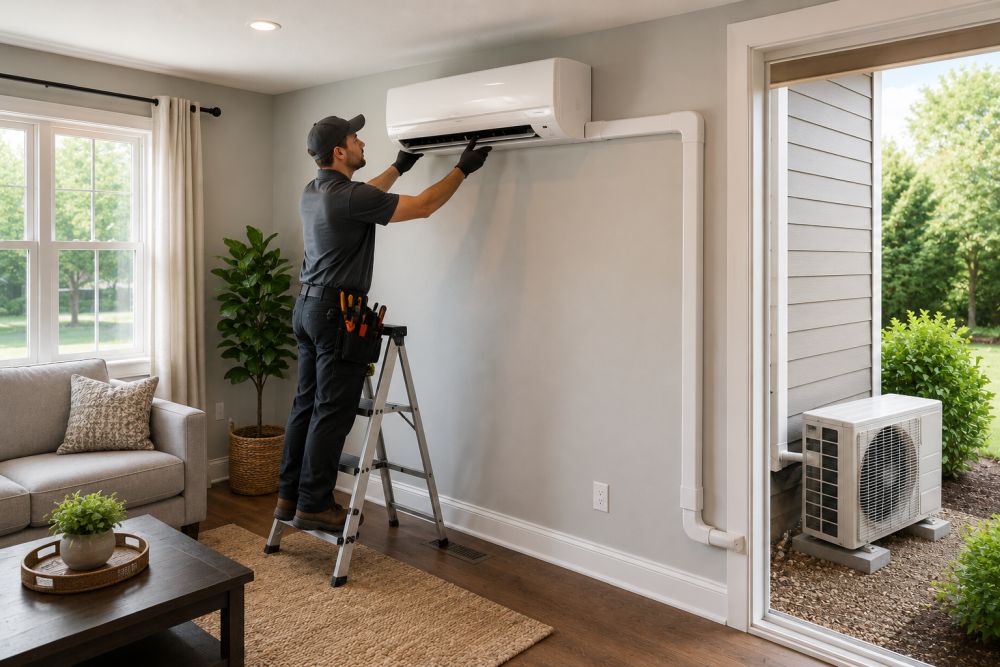
On installation day, licensed technicians handle the work. The line voltage and control wiring are pulled on a dedicated circuit sized for the unit’s nameplate. Linesets are run and brazed or connected per manufacturer practice, then pressure tested and evacuated. The refrigerant charge is set and verified by subcooling and superheat readings. Indoor units are leveled and anchored, and condensate lines are trapped and pitched. Outdoor units are set on composite pads or wall brackets to meet the clearance requirements. Final commissioning records are captured for the rebate file.
After installation, the team submits the post-installation documents, model and serial numbers, photos, and commissioning data. If the project is selected for a QA visit, the homeowner is notified and the brief visit is scheduled. The homeowner receives the rebate when the program closes the file. This sequence minimizes surprises and keeps the schedule reliable. It is the same workflow whether the project started as a whole-home heat pump replacement or a focused Ductless Mini-split Installation Durham CT project to retire window ACs on a tight timeline.
Local conditions that shape design choices
Homes along the Coginchaug River corridor and near Allyn Brook Park in Durham often face humidity loads that outsize their sensible temperature load in summer. That is why variable-speed heat pumps paired with correct duct sizing or correctly sized ductless indoor units excel in these homes. Long, low-speed runs wring moisture from the air and keep indoor relative humidity in a comfortable band. In winter, older capes and colonials near Durham Center and Rockfall benefit from cold-climate performance that carries heat deep into the season without frequent electric resistance backup.
Busy schedules matter too. Families near Wesleyan University and along Route 68 and Route 147 need clear install windows. Pre-registration reduces rescheduling caused by paperwork delays. For commercial and municipal buildings that serve the Click for info Durham Fair Grounds, clearances for outdoor units and service access must be planned around event traffic and site constraints. These are practical factors that an experienced local contractor bakes into the design.
Why pre-registration is also about future-proofing
The refrigerant transition and evolving test standards are baked into new model rollouts. SEER gave way to SEER2 and HSPF to HSPF2. New refrigerants such as R-454B are arriving in many heat pump product lines. Pre-registration forces the project to pick a current model that meets today’s standards and keeps the path clear for service and support. It also documents the system for future rebate or maintenance program opportunities. For homeowners who plan to electrify further with solar, having a documented, efficient heat pump on record aligns with financing and incentive programs that reward efficient electric loads.
In Durham and across Middlesex County, many oil-heated homes are choosing this path. A staged plan that starts with a ductless zone for the most-used room and expands in phases is common. Every phase should be pre-registered. Every phase should align with the load. That is how the project reads cleanly in a rebate file and performs well in real life. It is also how a search for Ductless Mini-split Installation Durham CT turns into a long-term plan that removes window ACs now and trims oil consumption each winter until the conversion is complete.
Serving Durham and central Connecticut from a Durham headquarters
Direct Home Services works from 57 Ozick Dr Suite i in Durham 06422. The location is minutes off Route 17 with reach up to Middletown 06457 and along Route 9, across Middlefield 06455 and 06481, out to Wallingford 06492, Cheshire 06410, Meriden 06450 and 06451, Cromwell 06416, Berlin 06037, Rocky Hill 06067, and Wethersfield 06109. The team installs and services heat pumps and ductless systems in homes, multi-family buildings, and small businesses across Middlesex County and central Connecticut. The company answers the phone all day and night, which matters when a homeowner is replacing a failed AC during a July heat wave or planning a winter conversion from oil to a heat pump before the first cold snap.
Local context matters. Durham Center has historic homes that demand careful lineset routing and discreet indoor unit placement. Madison’s coastal exposure raises salt and wind questions for outdoor units. Killingworth and Haddam present long rural runs where panel capacity and generator integration may enter the design. Cromwell and Meriden bring a mix of older ducted systems and new construction that suggest different heat pump options. A pre-registered, documented plan that reflects these conditions is the throughline that keeps the project on track and the rebate intact.
Who benefits most from a ductless-first approach
Homeowners who rely on window ACs each summer benefit immediately. A single-zone ductless system transforms sleep quality in an upstairs bedroom. It also adds efficient shoulder-season heat to that room. For teleworkers using a home office over a garage near Route 68, a ductless system stabilizes temperatures in a space that is hard to serve from the main duct system. For property owners who plan to sell in a few years, replacing a stack of window units with a permanent ductless installation is a visible upgrade buyers understand. These are the projects that often start with Ductless Mini-split Installation Durham CT in a search bar. They end with a clean install, a quiet room, and a rebate that showed up because the team pre-registered at the start.
What homeowners can expect from the rebate timeline
The exact calendar shifts as programs update rules. The general sequence stays steady. Pre-registration creates the project record. Installation proceeds under the approved scope. The contractor submits the post-install documents. A reviewer checks the file and may select it for a brief QA visit. The rebate is issued to the homeowner or assigned to the contractor if that arrangement was selected. If a step is missing, the reviewer requests it. When the file is complete, the rebate moves. The federal credit is a tax-time event, claimed when the homeowner files taxes for the year of installation. The up-to-$2,000 figure referenced on the site is a cap for qualifying heat pumps under the current federal program that applies in this market.
In busy seasons, the most common speed bumps are late model number photos and missing commissioning data. Those are solved with a disciplined handoff on installation day. That is another reason the pre-registration file matters. It is a checklist before it is a form. It keeps small misses from turning into delays.
Why Ductless Mini-split Installation Durham CT belongs in the rebate conversation
Ductless projects are often seen as quick upgrades that sit outside the rebate universe. In Connecticut, the opposite is true. Ductless heat pumps that meet the efficiency criteria and serve a meaningful portion of the home’s load are squarely in play for incentives. Pre-registration clarifies whether a single-zone project in a key living space qualifies. It also streamlines multi-zone projects that replace aging window ACs across an upper floor. This is why every professional conversation that starts with Ductless Mini-split Installation Durham CT should immediately include pre-registration steps and timing. It is not extra paperwork. It is the path that gets the homeowner the incentive the marketing materials talk about.
Why local expertise matters in Middlesex County
The difference between a smooth rebate file and a stalled one is often local knowledge. Inspectors in Durham and Middlefield want clean electrical labeling and visible disconnects. Historic districts near Main Street need discreet exterior line covers and thoughtful indoor unit placement. The microclimate near the Connecticut River throws humidity challenges that change how a system is sized for latent load, which is the moisture removal requirement. Cold snaps on clear nights in January approach the 0 degree design point, which tests a heat pump’s low ambient capacity. A contractor who works these neighborhoods daily does not guess at these conditions. They build them into the load calc and the equipment pick before they pre-register.
Why the final outcome is worth the front-loaded effort
The extra 30 minutes spent on pre-registration delivers benefits that last for years. The homeowner gets a correctly sized system that runs quietly and uses less energy. The rebate lowers the initial investment. The federal credit offsets taxes at filing. The paperwork file becomes a service record that supports maintenance, resale, and future electrification steps like solar. Most of all, pre-registration prevents that sinking feeling that hits when a homeowner learns after installation that the project is ineligible for the incentive they counted on.
Why Middlesex County property owners choose Direct Home Services
Direct Home Services is a family-owned Connecticut HVAC contractor with more than 40 years of experience, headquartered at 57 Ozick Dr Suite i in Durham 06422. The company is a Bryant Factory Authorized Dealer and is licensed in Connecticut under HTG.0350018-S2 and HIC.0668169. The team installs, repairs, and maintains heat pumps, ductless mini-splits, central air conditioners, furnaces, boilers, water heaters, indoor air quality systems, and WiFi thermostats for residential and commercial clients across Durham, Middletown, Middlefield, Killingworth, Haddam, Madison, Wallingford, Cheshire, Meriden, and Cromwell. Phones are answered 24/7. The company provides a free estimate with a written quote, helps coordinate Energize CT and Eversource rebates, assists with the federal heat pump tax credit, and offers financing, including no money down on solar and heat pump technology as referenced on the site.
If the goal is to replace window ACs with a permanent solution and secure incentives, start with pre-registration and a site visit. For Ductless Mini-split Installation Durham CT and for whole-home heat pumps, call Direct Home Services at (860) 339-6001. The team will size the system with a Manual J, specify Bryant or other qualifying equipment as appropriate, pre-register the project to protect your rebate, and schedule installation across Middlesex County and central Connecticut on a timeline that fits your season.